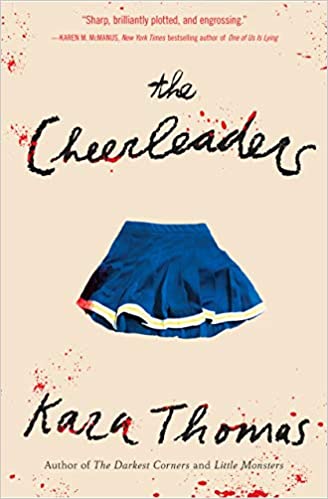
 I’ve been reading more suspense and thrillers lately, partially because I’m interested in turning one of my books into a suspense so I need to study up, and partially (of course) because I enjoy reading them. This was my first Kara Thomas book, but she apparently has some others, so I will be checking those out.
The book’s main character is Monica, whose sister was the last of her school’s five cheerleaders to die five years earlier. The first two were killed in a strange car accident that seemed to have no cause. The second two were murdered, with the murderer being killed by police (Monica’s stepfather) the next day. The final one was Monica’s sister, Jen, who killed herself—presumably out of despair over the other deaths.
Early on in the book, Monica stumbles across her sister’s old phone, stashed in the bottom drawer of her stepfather’s desk. There are also yearly anonymous letters saying
Connect the dots. Find the truth.
Monica doesn’t know what to think, but she has the guts to contact the number of the last call on Jen’s phone, which took place the morning she killed herself. And this kicks off Monica’s search for the truth. She figures out who the phone number belongs to and learns some critical information from him. She makes a new friend in the process of investigating and the two of them undertake some risky tasks.
The book also offers Jen’s point of view in some chapters (Monica has many more). This provides the reader with a little extra information, but it isn’t until the very end that we see how it all ties together (or doesn’t).
This is an engaging book with a few twists that surprised me. I won’t say it’s perfect—there were a couple of connections Monica made that I thought were a stretch, but not enough to keep me from wanting to know what happened. So if you enjoy YA thrillers, you should check this one out.
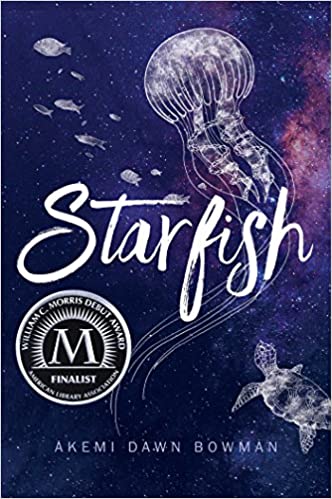 Starfish is the story of Kiko Himura, a 17-year-old Nebraska girl with a Japanese-American father and an obnoxiously white mother (who’s a total narcissist, but the way). Kiko’s mom has belittled her her whole life for not being “beautiful” like she (the mom) is. By beautiful, she means blonde and blue-eyed. Because Kiko takes after her father physically. To white people she’s too Japanese, and to Japanese people she’s too white. It’s not just her mom—the kids at school make sure she thinks this, too.
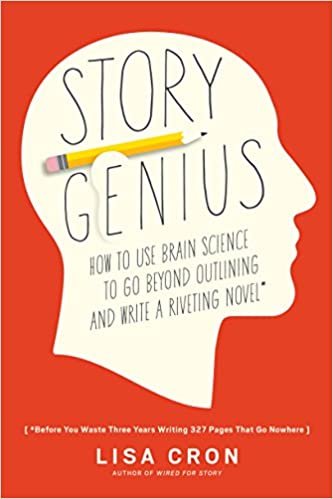 This won’t be a very exciting post. Not a lot to report. Like everyone else, I’m stuck in lockdown, going stir crazy. I usually do most of my writing at Starbucks, so it’s been a challenge to learn to work at home. Especially when I’m working from home for my day job, too. I just sit in the same chair from 7 am to 8 or 9 pm, swapping out computers at about 3:30. One nice thing that is helping me not go crazy is that some of my writing friends and I meet on Zoom every day and chat and do writing sprints. It helps to talk to other people.
 This is going to be an unusual review for this blog. Obviously I usually review YA fiction. But today, since I didn’t finish another book this week, I’m reviewing an adult fiction book that I think might still be of relevance to my readers. A lot of people have to get up on a stage—at work, in school, in church, wherever. This book could make you more comfortable doing so, and help you make a bigger impact.
 This book’s been sitting on my shelf a while (in very good company) and I decided I wanted a quick read that was not for my MFA, so I picked it up. It turned out to be perfect. Even though I’m in a bit of a reading slump, I read it in two days because it’s pretty fast-paced. It’s billed as a contemporary YA romance, but I’d argue it’s romantic suspense, although the suspense doesn’t get started right away.
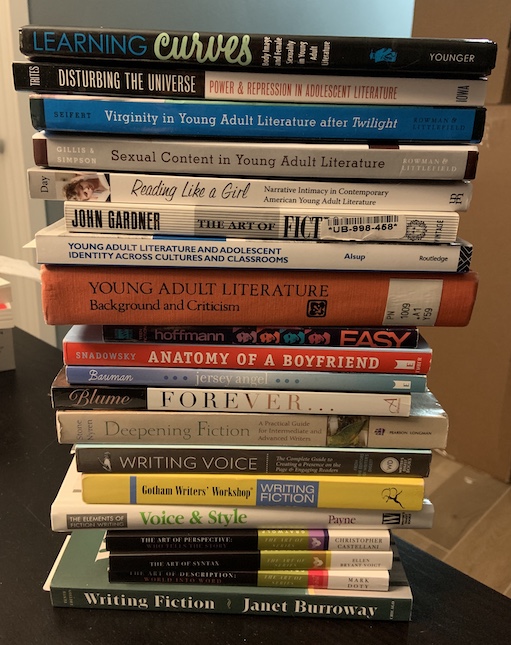
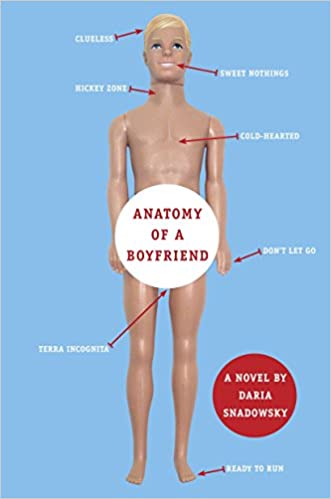 I really enjoyed Anatomy of a Boyfriend, which is a modern day Forever (I say that even though it was written in 2007—it’s aged well, I think). I love the cover, with its cheeky annotations. It’s true that some of the love scenes are a bit clinical, but for what the book is trying to do, it absolutely works.
 Riley Rose is an atheist, a cynic, and quite the rebel. She’s also fat, but she’s determined to make that irrelevant to her life. Her mother died a few years before the book opens and her dad turned all religious and acquired a super-Christian girlfriend. Riley is a bit of a party girl, and when she gets in trouble for breaking into a pool with a bunch of friends, her dad’s solution is to send her to church camp. Obviously.
 This is a quiet book about depression and how it can seemingly take over a person’s life and entire perspective, and then how to get away from it.
 Two Can Keep a Secret is the followup (not the sequel, that’s a different book) to McManus’s One of Us Is Lying, which I liked and
 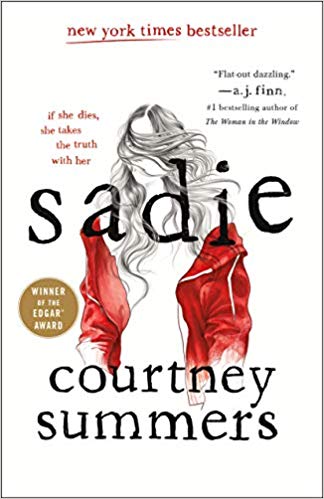 When I first heard about this book, I was sort of freaked out because of similarities it has with my own Sadie Speaks (still unpublished). I’m hoping I don’t have to change the name of my character because of it. Still, it sounded like an interesting book, so I bought it.
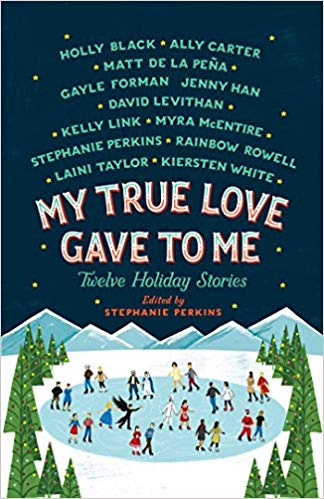 It’s probably a little odd to be doing a review of a holiday short story collection several weeks after the holidays ended, but since when did I claim to be normal. Besides, I started reading this before Christmas.